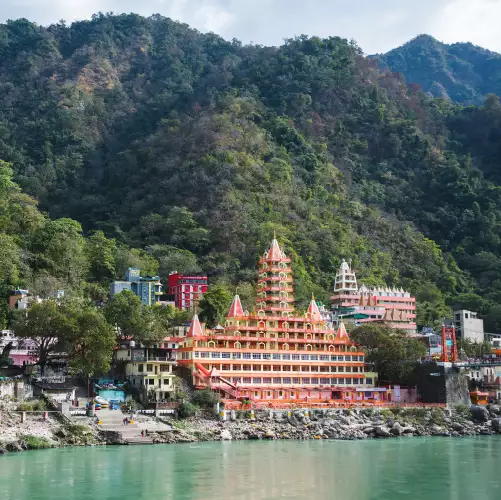
Haridwar sits at the foothills of the Garhwal Himalayas, at the point where the Ganga descends from the mountains into the Indo-Gangetic plain. The city’s name means “Gateway to God” — Hari (Vishnu) + Dwar (gateway), though it is also read as the gateway to Har (Shiva). By either interpretation, Haridwar marks the threshold between the mortal world and the sacred mountains — it is the starting point for the Char Dham Yatra to Badrinath, Kedarnath, Gangotri, and Yamunotri. The river here is fast, clear, and cold, visibly different from the broad, muddy Ganga of the plains downstream.
Har Ki Pauri: The Sacred Ghat
Har Ki Pauri is the most sacred ghat in Haridwar and one of the holiest spots on the Ganga. The name means “the feet of God” — a footprint said to be that of Lord Vishnu is embedded in the ghat’s upper platform. According to tradition, the Amrit (nectar of immortality) spilled here during the Samudra Manthan episode, which is the mythological origin of the Kumbh Mela. A drop of Amrit fell at four places — Haridwar, Prayagraj, Nashik, and Ujjain — and each of these cities hosts the Kumbh Mela in rotation.
The Ganga Aarti at Har Ki Pauri is performed every evening at sunset and is the defining experience of Haridwar. The main aarti is conducted by priests of the Gangasabha (a religious trust that has maintained the aarti tradition for over a century). Hundreds of small oil diyas (earthen lamps) are floated on the river after the aarti, and the sight of these lights drifting on the fast-moving current is genuinely memorable. Arrive 30–45 minutes before sunset to find a good spot on the steps.
The ghat has two levels — the lower, busier area where most pilgrims bathe, and the upper platform with the Vishnu footprint and the brass bell. Iron chains are installed along the steps for bathers to hold against the strong current. The water temperature is 14–18°C even in summer, significantly colder than rivers in the plains.
Kumbh Mela at Haridwar
Haridwar hosts the Kumbh Mela every 12 years (when Jupiter enters Aquarius and the sun enters Aries), and the Ardh Kumbh every 6 years. The Kumbh at Haridwar is the most compact of the four — the city is smaller than Prayagraj and the celebration feels more intimate. The principal bathing ghat for the Shahi Snan processions is Har Ki Pauri and the adjacent ghats. The last full Haridwar Kumbh was held in 2021 during the Covid period; the next will be in 2033.
Mansa Devi Temple
Mansa Devi Temple sits on Bilwa Parvat (Bilwa Hill), overlooking Haridwar and the Ganga. It is one of the Shaktipeethas and is dedicated to Mansa Devi, a form of Shakti believed to fulfil wishes. The temple is reached by a ropeway (cable car) from the base station near Har Ki Pauri — the ropeway takes about 3–4 minutes and offers excellent views of the city and river below — or by a footpath of about 1 km. The temple receives very high footfall on Navratri, Sundays, and auspicious Mondays. Timings: 6:00 AM to 8:00 PM (October–March), extended hours in summer. The ropeway fee is approximately ₹115 for a return ticket (subject to revision).
Chandi Devi Temple
Chandi Devi Temple is on Neel Parvat (Neel Hill), on the opposite side of the city from Mansa Devi. It is also a Shaktipeeth — the legend says that after Chanda and Munda (two demon commanders of Shumbha and Nishumbha) were killed by Chandi (a fierce form of Durga), the goddess took up residence on this hill. The ropeway to Chandi Devi from Shri Chandi Devi Ropeway Station is separate from the Mansa Devi cable car. Many pilgrims complete what is called the “teen devi darshan” — visiting Mansa Devi, Chandi Devi, and Maya Devi Temple in a single day.
Maya Devi Temple: The Ancient Heart of Haridwar
Maya Devi is considered Haridwar’s Adhishthatri Devi — the presiding goddess of the city. The temple is one of the oldest in Haridwar, and is a Shaktipeeth associated with the heart (or navel, according to some traditions) of Sati. It sits within the older part of the city, near Har Ki Pauri, and is a 24-hour temple. The idol is an unusual multi-headed form — three faces, four arms — and the atmosphere inside is intense, especially at dawn.
Daksha Mahadev Temple
The Daksha Mahadev Temple at Kankhal (about 4 km from Har Ki Pauri) is built on the site of the legendary Daksha Yajna — the sacrificial ceremony conducted by King Daksha (Sati’s father) at which he insulted his son-in-law Shiva by not inviting him. Sati, unable to bear the insult to Shiva, immolated herself at this yajna, which ultimately led to the catastrophic events that ended with Vishnu’s Sudarshana Chakra dividing Sati’s body into 51 pieces, creating the Shaktipeethas. The temple is both a Shiva shrine and a place of reflection on the consequences of pride and disrespect. The Kankhal area around the temple has many ashrams.
Rishikesh: 25 km from Haridwar
Rishikesh is 25 km north of Haridwar — the two are almost always visited together. Rishikesh is the “Yoga Capital of the World,” a city of ashrams, yoga centres, meditation retreats, and adventure sports on the Ganga. The Laxman Jhula suspension bridge (now restricted to pedestrians and motorcycles) and Ram Jhula span the Ganga and have been Rishikesh’s iconic landmarks for decades. The evening aarti at Parmarth Niketan ashram’s ghat is atmospheric and distinct from Haridwar’s — more contemplative, smaller in scale, with floating diyas and chanting by the ashram’s residents and guests.
From Haridwar and Rishikesh, the road north leads to the Char Dham: Kedarnath, Badrinath, Gangotri, and Yamunotri. Haridwar is the last major city before the mountain roads begin and serves as the logistical base for all Char Dham itineraries.
Ashrams and Spiritual Life
Haridwar has been a centre of ashram culture for over a century. Shantikunj (headquarters of the All World Gayatri Pariwar) runs regular courses on the Gayatri Mantra, Yajnas, and life-positive practices; it accepts visitors and runs free residential courses. Patanjali Yogpeeth, established by Baba Ramdev and Acharya Balkrishna, covers a large campus in Haridwar and is open to visitors; the pharmacy and Ayurvedic products store here are the original source of the Patanjali brand. Saptarishi Ashram, 5 km upstream, is one of the older establishments; it sits at a wide bend of the Ganga where seven rishis are said to have meditated, causing the river to split into seven channels to avoid disturbing them.
Haridwar Markets and Shopping
The bazaars around Har Ki Pauri and on Moti Bazaar Road are the oldest and liveliest commercial areas. Rudraksha beads, from single-face (Ek Mukhi) to 14-faced and beyond, are available here in large quantity — Haridwar is one of the best markets in India for Rudraksha. Genuine ones should be bought from reputable shops with certifications; the price varies enormously by face count and grade. Ganga Jal in copper or brass containers is widely purchased by pilgrims — Haridwar’s water is the standard benchmark of sacred Ganga water for ritual use across North India. Copper and brass ware (lamps, Ganga jugs, ritual implements), Ayurvedic herbs and formulations, and devotional items (idols, malas, tilak powders) fill the market lanes.
Ganga Jal and the Kanwar Yatra
Every year during Shravan month (July–August), hundreds of thousands of Kanwariyas — devotees of Shiva, typically young men and women dressed in saffron — walk to Haridwar to collect Ganga water in decorated pots (kanwars) and carry it back on foot to Shiva temples in their home districts, sometimes walking 100–200 km each way. This Kanwar Yatra is one of the world’s largest pedestrian religious processions. During this period, the main Haridwar–Delhi highway is partially closed to vehicular traffic for stretches to allow the procession to pass.
Practical Travel Information
Getting there: Haridwar Railway Station is well-connected — direct trains run from Delhi (Haridwar Express, approximately 4–5 hours), Mumbai, Kolkata, Chennai, and other major cities. The nearest airport is Jolly Grant Airport at Dehradun (35 km, about 1 hour by road). By road, Haridwar is 230 km from Delhi via NH58, approximately 5–6 hours by car depending on traffic.
Getting around: The Har Ki Pauri area and surrounding temples are walkable if you stay close to the ghats. Autos and e-rickshaws run between the main areas. Rishikesh is 30–40 minutes by shared bus or auto from Haridwar (Rahi Motel bus stand).
Best time to visit: October to March is the most comfortable. April–June is warm but manageable. Avoid mid-July to mid-August unless specifically visiting for Kanwar Yatra (very crowded, loud, and logistically demanding). The Ganga aarti is best experienced on weekdays when crowd levels are lower.
Alcohol and meat: Haridwar is officially a dry city — alcohol sales are prohibited. This applies to the entire city. Meat is also not available near the temples and ghats; the culinary culture here is strictly vegetarian and sattvic.
A Delhi–Haridwar–Rishikesh itinerary is one of the most popular short trips from the capital. Our Delhi–Agra–Haridwar–Rishikesh tour package covers these destinations in a well-paced 7-day format.