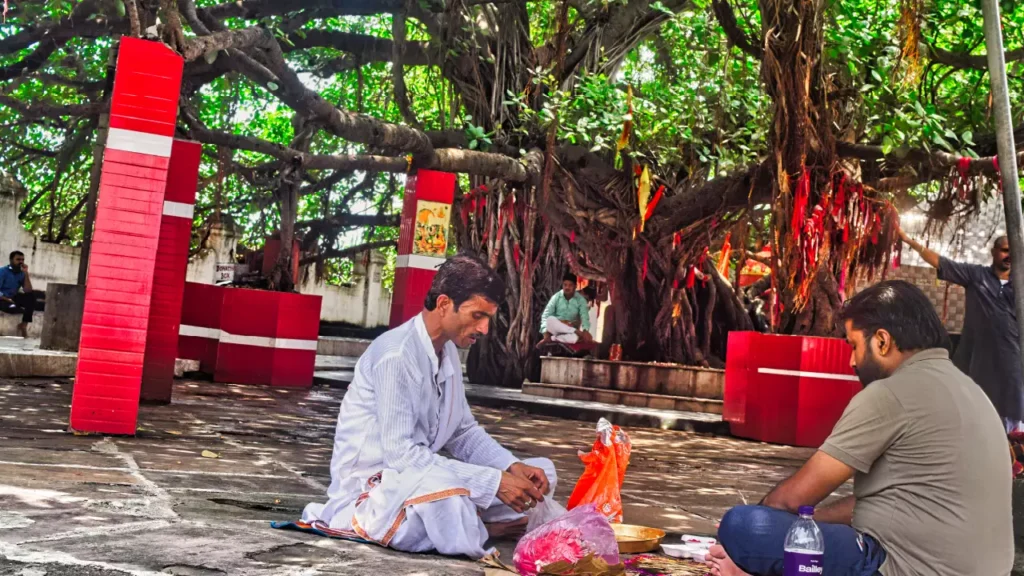
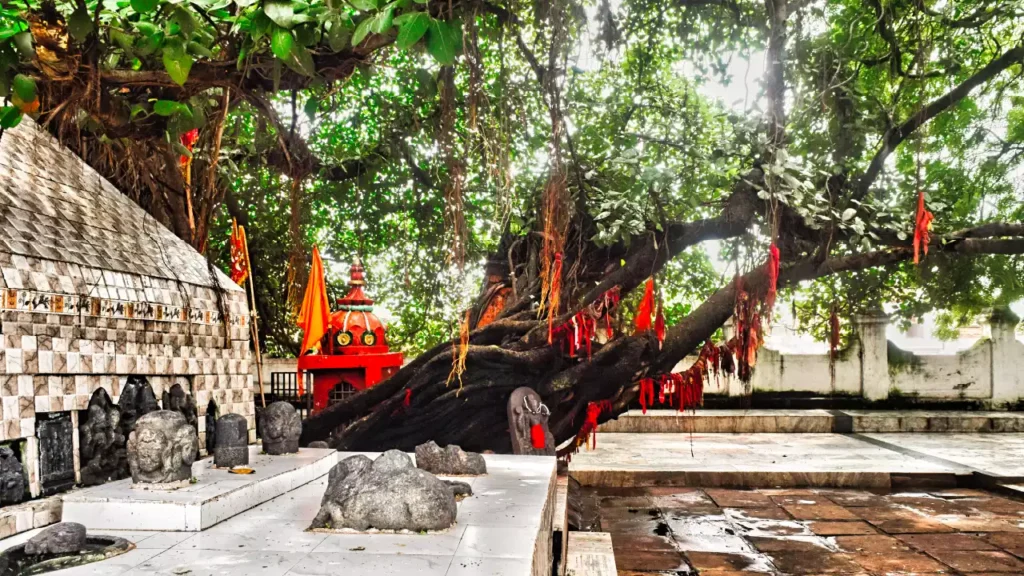
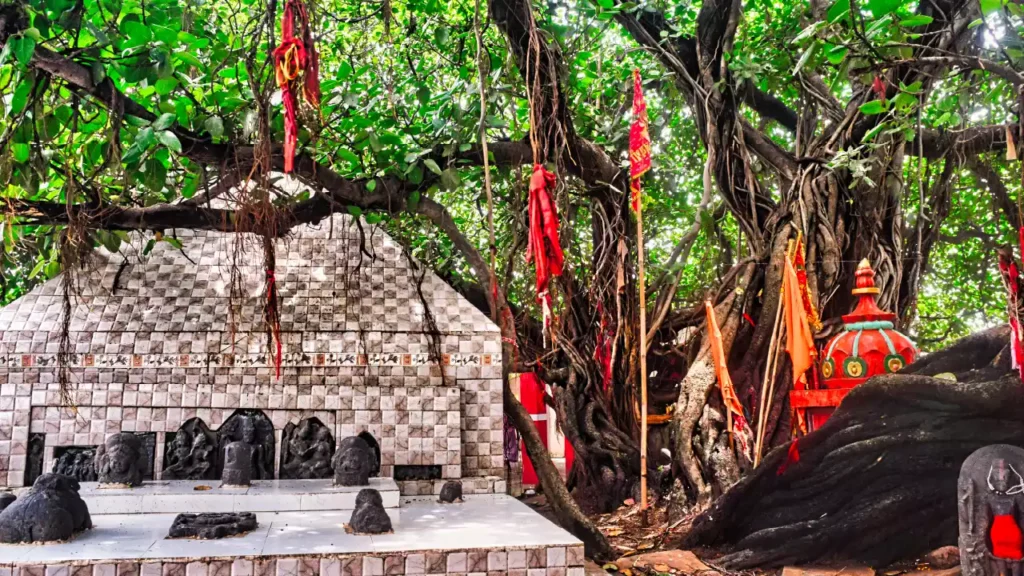
The Akshayvat — the Immortal Banyan Tree — in Gaya is one of the most theologically layered sacred sites in all of Hindu pilgrimage. Located in close proximity to the Vishnupad Temple on the banks of the Falgu River, this ancient tree is mentioned by name in multiple scriptural traditions: the Puranas, the Ramayana, and Jain texts all reference it, each placing it at the centre of a different narrative about divine power, cosmic continuity, and the endurance of the sacred across time.
The Blessing of Sita
The most widely known story about Akshayvat concerns Sita, wife of Lord Rama, during the period when Rama and Sita came to Gaya to perform Pind Daan for Rama’s father, King Dasharatha. The Ramayana and later Puranic sources describe Sita stopping at this tree and offering it a blessing: that it would be eternal, always green, never losing its leaves regardless of season. The name Akshayvat comes directly from this event — akshaY means imperishable or undecaying, and vat is the Sanskrit word for banyan tree. The tree is therefore not merely old; it is scripturally held to be outside the normal cycle of growth, decay, and death.
This makes Akshayvat a uniquely appropriate site within Gaya’s ritual landscape. Gaya is a city defined by its relationship to death and ancestral continuity — the Pind Daan performed here is believed to liberate souls from the cycle of rebirth. The presence of an eternal, undying tree at the heart of this landscape carries a significance that is more than symbolic. It is a physical counterpoint to the mortality that pilgrims are here to address.
The Flood Story — Lord Narayan and the Sage Markandeya
A second tradition surrounding Akshayvat involves Lord Vishnu (in the form of the infant Narayana) and the sage Markandeya. According to this account, Vishnu once flooded the entire earth to test the sage, who had boasted of having witnessed multiple cosmic cycles. As the floodwaters rose and covered everything, the only object that remained above the surface was a solitary banyan tree — Akshayvat — upon which the infant Narayana lay sleeping, sustained on a leaf floating in the primordial waters. Markandeya, entering the child’s mouth in the manner described in the Puranas, witnessed the entire universe contained within. The story connects Akshayvat to the imagery of cosmic dissolution and renewal that runs through Vaishnava cosmology.
The Rama Connection
The Ramayana places Akshayvat on Lord Rama’s route when he came to Gaya with Sita and Lakshmana to perform Shraddha for King Dasharatha. In the most dramatic version of this story, Dasharatha’s soul appeared and specifically asked that Pind Daan be performed by Sita rather than Rama — a request that Sita fulfilled at Phalguni Ghat in the absence of Rama and Lakshmana. Akshayvat is one of the witnesses to this event, along with the Falgu River itself and the crow (identified with Indra) who confirmed what Sita had done. The sacred site thus carries the weight of one of Hinduism’s most detailed ancestral rites narratives.
Jain Significance
Jain scriptures add a further layer to Akshayvat’s sacred biography. The texts identify this tree as a place where Rishabhanatha — the first tirthankara (ford-maker, spiritual teacher) of the current cosmic cycle in Jain cosmology — spent extended periods in meditation. For Jain pilgrims visiting Gaya, Akshayvat carries the significance of this connection to their tradition’s founding figure, making it a site of importance across two major religious systems simultaneously.
Pind Daan Ritual Connection
The sanctity of Akshayvat has a direct bearing on the efficacy of Pind Daan performed in Gaya. Pilgrims performing ancestral rites are often advised by their pandits to visit Akshayvat as part of the full Gaya circuit, which typically includes Vishnupad Temple, Phalguni Ghat (Falgu River), Pretshila Hill, and Mangal Gauri Temple. Touching the roots of the sacred tree and offering prayers is considered to enhance the merit transferred to the departed ancestors through the Pind Daan ritual. Some families perform a brief tarpan (water offering) at the base of the tree before proceeding to the main ritual sites.
Visiting Information
- Location: Near Vishnupad Temple, on the Falgu River bank, central Gaya
- Access: Easily reached on foot from Vishnupad Temple; rickshaws available from Gaya Junction railway station (approximately 5 km)
- Timings: Accessible throughout daylight hours as part of the Vishnupad Temple precinct
- Entry: Free
- Best time to visit: Early morning during Pitrupaksha (September-October) when the entire Gaya pilgrimage circuit is in active use
- Photography: Permitted; the tree’s spread and the river backdrop make it one of Gaya’s most photographed sites
Akshayvat is best visited as part of a structured Gaya pilgrimage circuit. Our Gaya Pind Daan tour package includes Akshayvat, Vishnupad Temple, Phalguni Ghat, and all other ritual sites with experienced pandit guidance. For full context on Gaya’s sacred geography and how to plan your visit, see our Gaya travel guide.