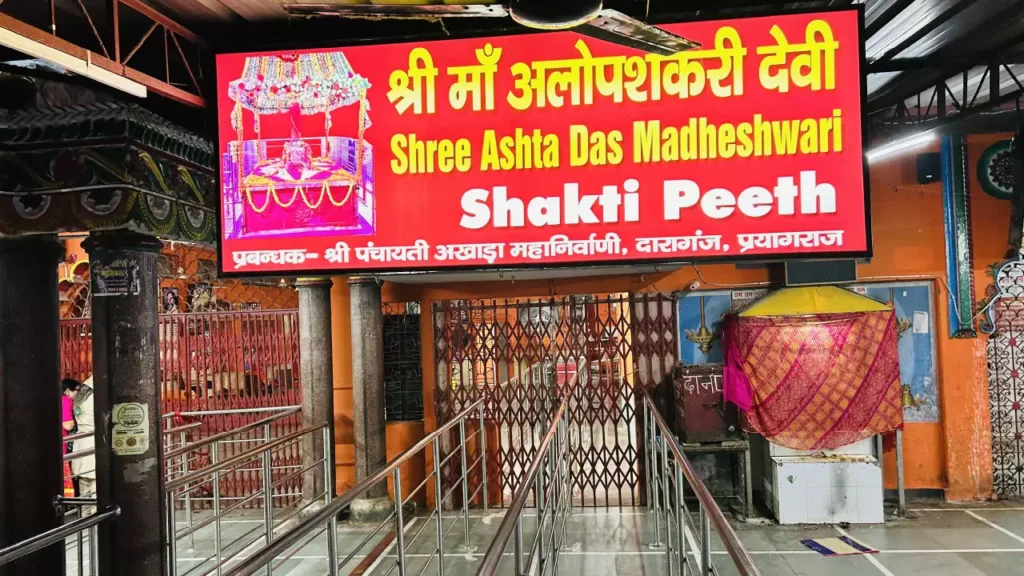
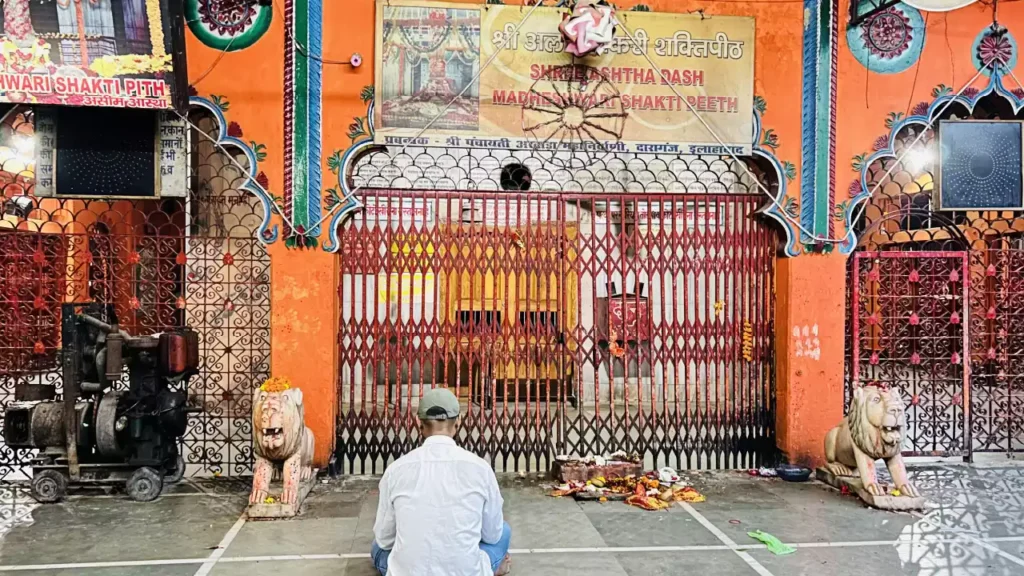
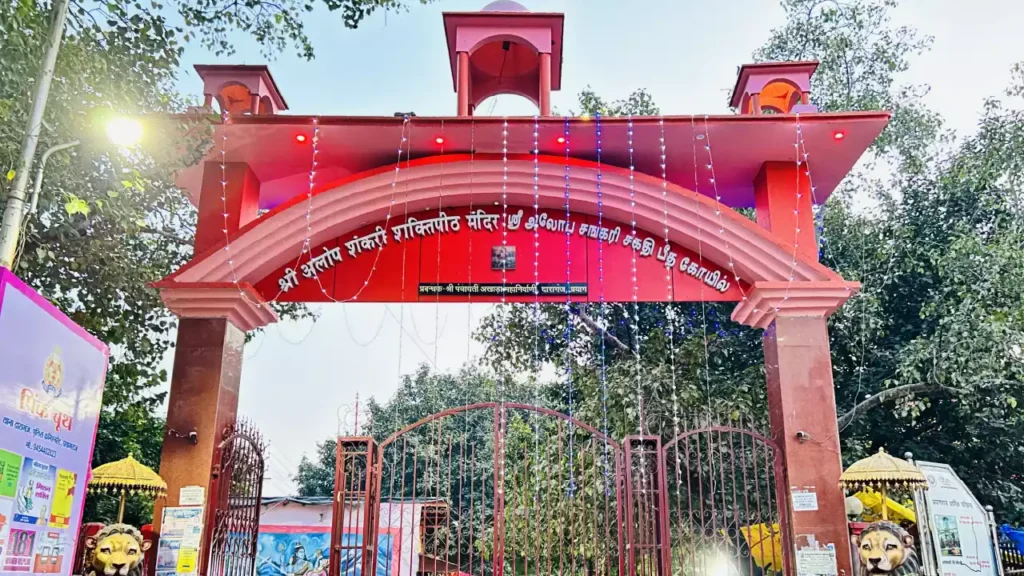
Alopi Devi Temple in Prayagraj is one of the most distinctive Shakti Peethas in all of India — distinctive because there is no idol of the goddess here. No murti, no carved image, no painted face looks back at devotees from the inner sanctum. Instead, at the centre of the temple hangs a small cradle (palki or doli) — a simple wooden swing draped with cloth and adorned with flowers. This cradle is the living presence of Alopi Devi, and it is to this humble swinging cradle that thousands of pilgrims bow their heads in reverence each day.
The temple is located in the Alopi Bagh neighbourhood of Prayagraj, close to the Triveni Sangam, and near the Nagvasuki and Veni Madhav temples. It is classified as one of the 51 Shakti Peethas — the sacred sites where the body parts of Goddess Sati fell to earth following her self-immolation, as Lord Shiva carried her body across the cosmos in inconsolable grief.
The Legend of Alopi Devi: Where the Goddess Vanished
The story behind this temple is one of the most poignant in the Shakti Peeth tradition. When Goddess Sati (the first wife of Shiva) sacrificed herself in her father Daksha’s fire, the grieving Shiva picked up her body and began roaming the universe, lost in sorrow. To release Shiva from this grief — and to prevent the cosmos from descending into chaos under a mourning god — Lord Vishnu intervened. Using his Sudarshana Chakra (discus), he cut the body of Sati into pieces, which fell at different locations across India. Each site where a body part fell became a Shakti Peeth.
The final piece of Sati’s body to fall was her right hand — and it fell here, in what is now Prayagraj. But this last piece did not merely fall and settle. According to tradition, it vanished (alopi) at this spot — disappeared completely into the earth, leaving behind no physical remnant, only the invisible and all-pervasive presence of the goddess. The name “Alopi” is derived from the Sanskrit word for vanishing or disappearing. Because the goddess has no physical form here, the cradle serves as her aniconic representation — an absence that paradoxically feels more charged than any image could.
The Swinging Cradle and Temple Customs
The cradle at the heart of the inner sanctum is the primary object of worship. Devotees approach, offer flowers and sindoor, and are permitted to set the cradle gently swinging as an act of worship. Many devotees report that the cradle swings on its own even when the temple is locked and no one is present — a phenomenon cited as evidence of the goddess’s living, active presence at this site.
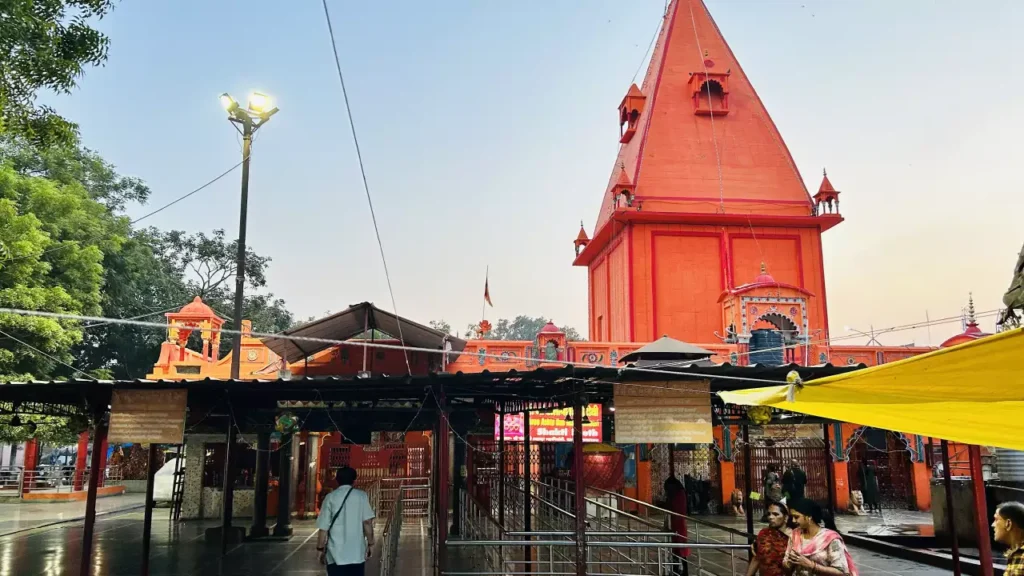
The temple’s inner compound is relatively compact and follows the Nagara architectural style in its basic form, though the building itself is of modest scale compared to some of Prayagraj’s larger shrines. The outer walls are painted in the typical ochre-red associated with Shakti temples.
It is worth noting that this temple is considered one of the three most important temples of Prayagraj for women — alongside the Saraswati Koop (the sacred well where the subterranean Saraswati is said to flow) and Lalita Devi Temple at Mirzapur. Women in difficult circumstances — seeking a healthy pregnancy, relief from family trouble, or blessings for a daughter’s marriage — come here with particular devotion.
Festivals and Special Occasions
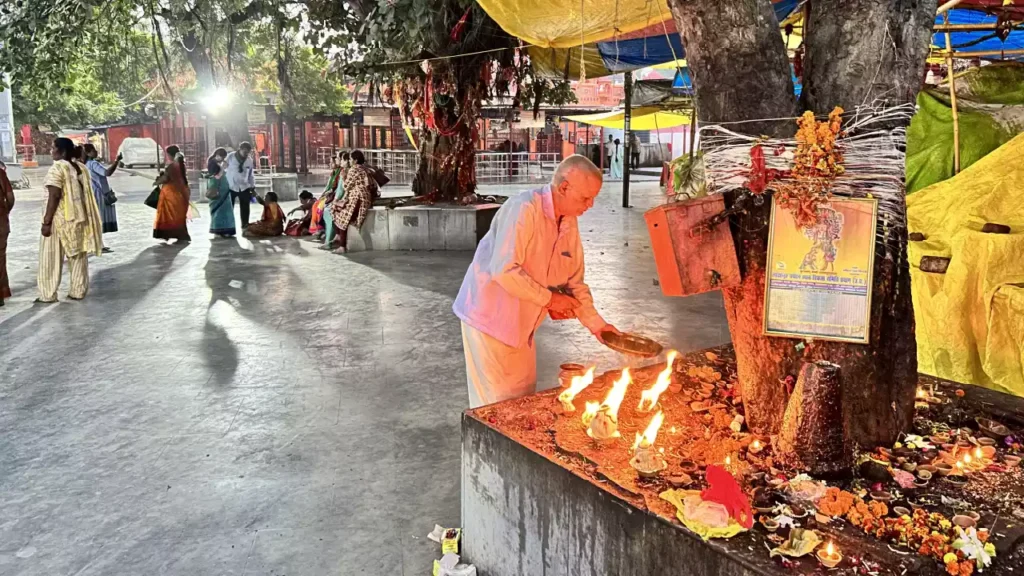
Navratri is the grandest festival at Alopi Devi Temple, drawing enormous crowds for nine consecutive days of celebration. During Kumbh Mela and Ardh Kumbh Mela, the temple becomes a major stop on the pilgrims’ circuit along the Sangam, and it is common to find queues of several hundred people waiting for darshan at any given time. Tuesdays and Fridays are considered particularly auspicious for visiting this goddess, and daily footfall on these days is noticeably higher.
Navami (the ninth day of Navratri) is celebrated with a special havan and kumari puja, in which young girls are worshipped as manifestations of the goddess and served a ritual meal. This practice, called Kanjak, is observed by the temple and by households across the city.
Spiritual Significance in Prayagraj
Prayagraj is already one of the holiest cities in Hinduism by virtue of the Triveni Sangam — the confluence of the Ganga, Yamuna, and mythical Saraswati rivers. Within this sacred geography, Alopi Devi Temple occupies a position of unique importance as the site of the final Shakti Peeth. Pilgrims who come to take a holy dip at the Sangam traditionally also visit Alopi Devi as part of their tirth (pilgrimage) — the goddess and the river confluence together representing the complete sacred geography of Prayagraj.
Explore the sacred sites of Prayagraj, including Alopi Devi Temple, the Sangam, and the city’s major temples, through our comprehensive Prayagraj pilgrimage and travel guide. Visit on our Varanasi-Prayagraj 2N/3D tour package, which covers the major temples and ghats of both sacred cities.
How to Reach
The temple is located in Alopi Bagh, Prayagraj, approximately 6 kilometres from Prayagraj Junction railway station. Auto-rickshaws and city buses are available from the station and from Prayagraj Civil Lines. The temple is also accessible from the Sangam area by a 15-20 minute auto-rickshaw ride. Entry is free. Photography inside the inner sanctum is typically restricted, and visitors are asked to maintain silence in the immediate vicinity of the cradle.