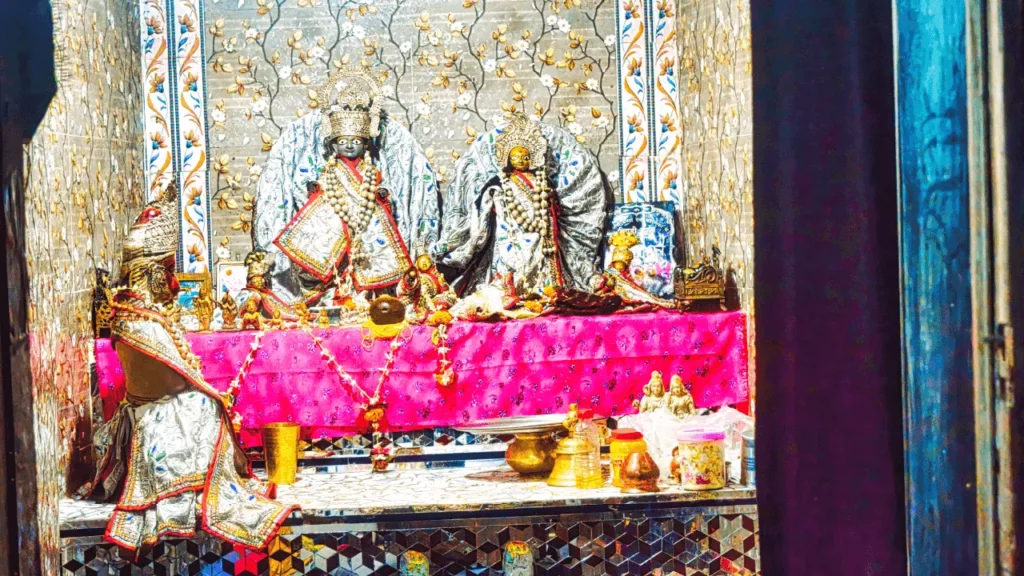
Nageshwarnath Temple in Ayodhya carries a distinction that no other temple in the city can claim: it is the only shrine believed to have survived intact from the era of Lord Ram’s son Kush, enduring through the Mughal period when much of Ayodhya’s religious heritage was destroyed or transformed. That alone makes it a site of extraordinary historical and spiritual significance. But the temple’s story is also one of a young prince, a lost armlet, and a love that led to the founding of a Shiva shrine in the middle of a city dedicated to Vishnu’s avatar.
The Legend of Kush and the Naga Kanya
The founding legend of Nageshwarnath Temple begins with Kush, the son of Lord Ram and Goddess Sita. After Ram’s return to Ayodhya and the subsequent events of the Uttara Kanda, Ram’s twin sons Luv and Kush grew up in the ashram of Sage Valmiki before returning to Ayodhya. Kush eventually ruled Ayodhya after Ram, and he is credited with several construction projects in the city.
According to tradition, Kush was bathing in the Sarayu river near what is now the Theri Bazaar area when his armlet (bajuband) slipped off and was carried away by the current. The armlet was found by a Naga Kanya — a celestial serpent maiden — who was herself a devotee of Lord Shiva. When Kush searched for his armlet and encountered the Naga Kanya, a bond formed between them. The Naga Kanya, being a Shaiva devotee, expressed her desire to have a temple of Shiva built at that spot. Kush, out of respect for her devotion and affection, had the temple constructed. This is how Nageshwarnath — Lord Shiva as the Lord of the Nagas — came to be enshrined in Ram’s Ayodhya.
The Only Surviving Pre-Mughal Temple of Ayodhya
Ayodhya’s sacred geography underwent massive disruption during the Mughal period. Many temples were demolished or converted, and the city’s ancient spiritual topography was significantly altered. Against this backdrop, Nageshwarnath Temple stands as a remarkable exception. Historians and devotees alike point to this temple as the one structure in Ayodhya that maintained its sanctity and physical presence through the Mughal era without being dismantled.
The temple was later renovated around 1750 CE by Naval Rai, who served as minister to Nawab Safdar Jung. This 18th-century restoration gave the temple much of its present architectural form, but the site itself and the core sanctum are held to be far older — tracing their origin to the time of Kush, which places them in the Treta Yuga according to scriptural chronology, or at minimum to a period many centuries before the Common Era in historical terms.
A Shaiva Shrine in a Vaishnava City
Ayodhya is principally associated with Lord Ram — a Vaishnava pilgrimage city par excellence. Nageshwarnath Temple is an interesting theological counterpoint: a Shiva shrine deeply embedded in the fabric of Ayodhya’s sacred life. This is not unusual within the broad tradition of Sanatana Dharma, where Shiva and Vishnu are understood as two aspects of the same supreme reality. Ram himself is depicted in the Ramayana as a devotee of Shiva — he worshipped Shiva at Rameshwaram before building the bridge to Lanka. So a Shiva temple founded by Ram’s own son fits naturally into the religious ecosystem of Ayodhya.
The temple attracts a distinct category of devotees — Shaiva pilgrims who come to Ayodhya specifically for Nageshwarnath, in addition to the large Vaishnava population that visits for Ram Janmabhoomi and Kanak Bhawan. This dual religious traffic makes the Theri Bazaar area around the temple one of Ayodhya’s more spiritually layered neighbourhoods.
Mahashivaratri: The Temple’s Greatest Celebration
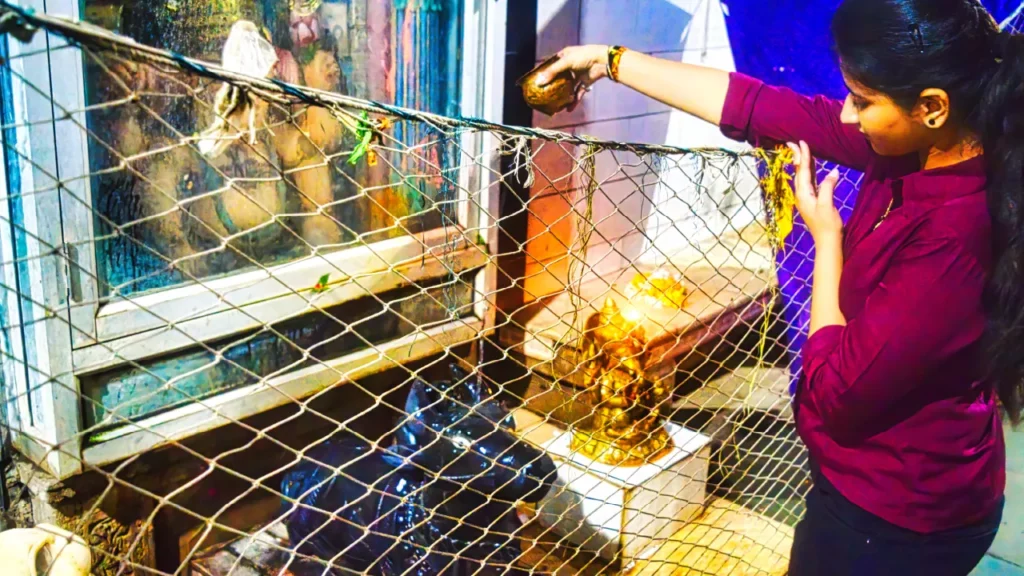
The most significant festival at Nageshwarnath is Mahashivaratri, celebrated on the 14th night of the dark fortnight in Falgun (February-March). On this night, the temple is lit and decorated, priests conduct special abhishek (ritual bathing of the Shivalinga with milk, honey, and water), and thousands of Shiva devotees gather for night-long prayers and bhajan. The Shiva Barat — the ceremonial procession of Lord Shiva as a bridegroom — is a major spectacle on Mahashivaratri, drawing participants from across Uttar Pradesh.
Pradosh Vrat, observed on the 13th day of each lunar fortnight (Trayodashi), is also an important ritual occasion at Nageshwarnath. Devotees from across the region visit on Pradosh evenings to perform abhishek and seek Shiva’s blessings. The temple also sees increased footfall during the month of Shravan (July-August), which is considered Shiva’s sacred month, and during Sawan Mondays when devotees offer Gangajal and bel leaves to the Shivalinga.
Architecture and Atmosphere
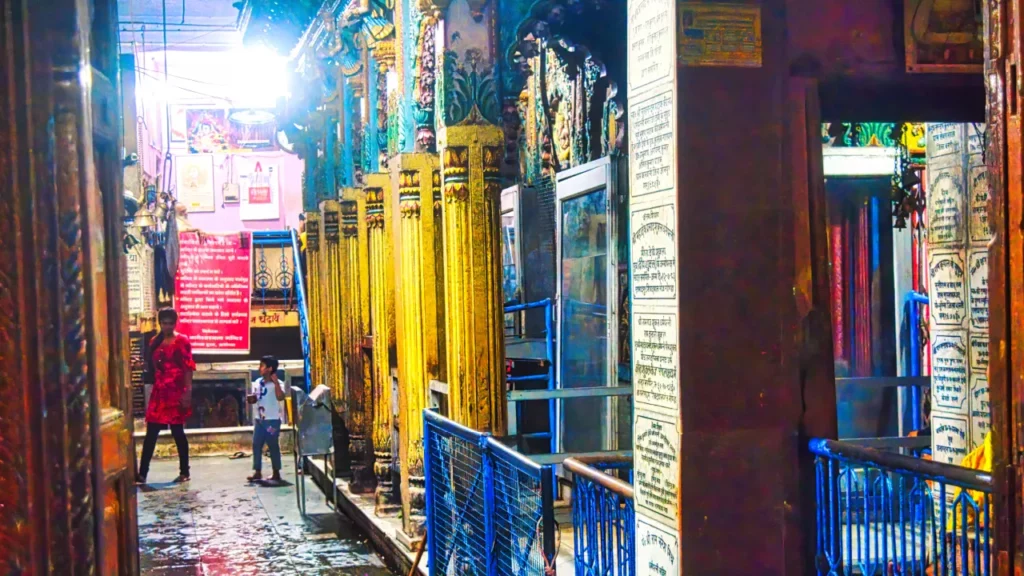
The temple’s architecture reflects the Nagara style common to North Indian temples, with a shikhara (spire) rising above the sanctum. The interior is modest but charged with devotional intensity — the Shivalinga at the centre of the sanctum is the object of all worship, dressed with flowers, bel leaves, and dhatura as is traditional in Shiva temples. The surrounding precinct includes smaller shrines to Nandi, Parvati, and Ganesh. The location near Theri Bazaar means the temple is surrounded by the sounds and smells of a working neighbourhood, which gives it a lived-in, everyday sanctity rather than the more formal atmosphere of a large pilgrimage complex.
For visitors planning a comprehensive Ayodhya circuit, Nageshwarnath fits naturally alongside the Ram Janmabhoomi temple, Kanak Bhawan, Hanuman Garhi, and Dashrath Mahal. Explore our Ayodhya travel guide for a full map of the pilgrimage circuit and practical advice on visiting hours and routes. Our Varanasi-Prayagraj-Ayodhya 3N/4D tour includes all major temples across the three sacred cities of Uttar Pradesh.