Ram Mandir — The Temple of Rama’s Birthplace
The Shri Ram Janambhoomi Temple in Ayodhya is the most anticipated religious construction project in modern India — a grand temple built at the site traditionally identified as the birthplace of Lord Rama, the seventh avatar of Vishnu and the hero of the Ramayana. The consecration ceremony (Pran Pratishtha) on January 22, 2024, was a moment of enormous national and spiritual significance, attended by the Prime Minister and watched by hundreds of millions of people. The presiding deity, Ram Lalla (the infant Rama), now resides in a sanctum that took decades of legal, political, and devotional struggle to establish.
For Hindus, Ayodhya is the Sapta Mokshapuri — one of seven sacred cities where liberation from the cycle of birth and death is attainable. And at the heart of Ayodhya is the Janambhoomi: the exact ground where Rama was born into the Ikshvaku dynasty as the son of King Dasharatha and Queen Kaushalya. This site is not merely symbolically important — devotees believe that the ground itself holds divine energy accumulated over millions of years of prayer and remembrance.
The History Behind the Temple
The recorded history of the Janambhoomi site is long and contested. The Babri Masjid was constructed in 1528 CE during the reign of the Mughal emperor Babur, reputedly over an older temple marking Rama’s birthplace. For centuries, Hindu devotees continued to worship at the site. In 1859, the colonial administration divided the compound, allowing Hindus to use the outer courtyard and Muslims the inner structure.
The legal dispute over the site lasted over 70 years. On November 9, 2019, the Supreme Court of India delivered a unanimous verdict awarding the disputed 2.77-acre plot to the Ram Janambhoomi Nyas for temple construction, and directing the central government to provide an alternative 5-acre plot for a mosque. The verdict ended the longest-running property and religious dispute in Indian legal history.
Construction of the new temple began in August 2020 and the ground-breaking ceremony (Bhoomi Pujan) was performed by the Prime Minister on August 5, 2020. The main sanctum was completed and consecrated on January 22, 2024 — Makar Sankranti period — in a 6-day ceremony that drew lakhs of pilgrims from across India and the world.
Architecture of the New Temple
The Ram Mandir is designed in the Nagara style of North Indian temple architecture by architect Chandrakant Sompura, whose family has designed over 200 temples. The temple is built entirely from pink sandstone quarried from Rajasthan’s Bansi Paharpur mines — no iron or steel is used in the main structure. The dimensions are remarkable: the main temple is 380 feet long, 250 feet wide, and 161 feet tall. There are five mandapas (halls) and a total of 360 pillars in the main complex.
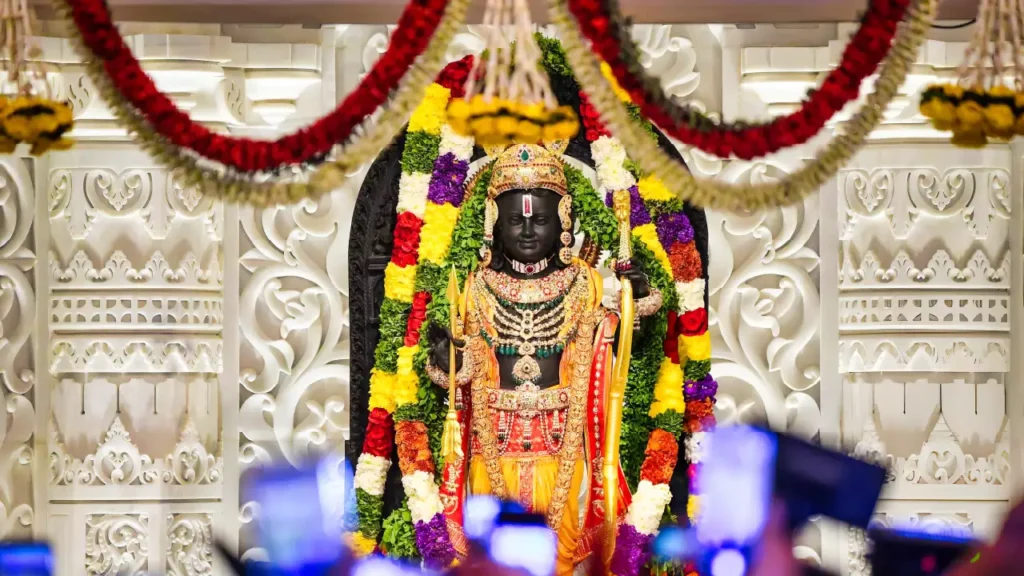
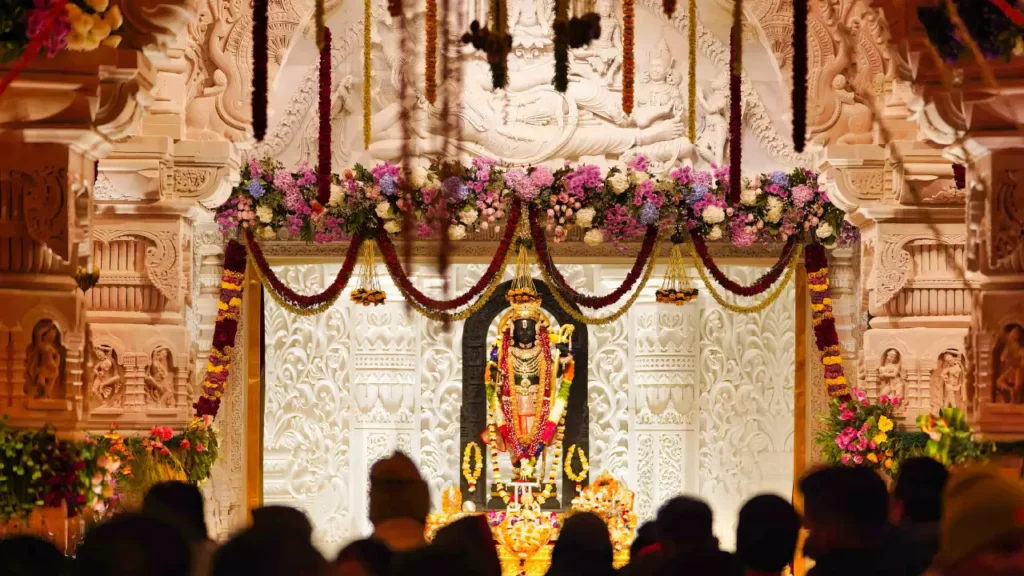
The sanctum sanctorum (garbhagriha) houses the Ram Lalla idol — a 51-inch standing image of the infant Rama in black stone, sculpted by the artist Arun Yogiraj from Mysore. The idol depicts Ram Lalla at the age of five, standing with a bow and arrow and wearing a crown. The idol radiates an expression of divine innocence and royal bearing simultaneously.
The full temple complex, spread across 70 acres, will eventually include temples to the Saptarshi (seven sages), a Vedic school, a pilgrimage facilitation centre, and heritage structures. The compound walls are decorated with sculptures from the Ramayana narrative and with images of 108 sacred pilgrimage sites.
Ram Lalla — The Presiding Deity
Ram Lalla (“Infant Rama”) has been worshipped at this site for centuries, even during periods when the precise location of the sanctum was disputed. A small idol of Ram Lalla was kept in a tent within the compound from 1949 until the temple’s inauguration. The idol now installed in the new garbhagriha is a newly sculpted image, but the divine presence — Ram Lalla — is considered the same eternal deity who has always resided here.
The Pran Pratishtha ceremony on January 22, 2024, was conducted by a team of 121 scholars from Varanasi under the guidance of the Kashi Vidwat Parishad. The ceremony lasted 84 hours over six days, following Vedic rituals that included the consecration of water (Jalabhishek), the reading of Ramayana, and the formal invocation of Rama’s divine presence into the idol.
Darshan Timings
- Summer (April–September): 7:00 AM – 11:00 AM and 2:00 PM – 9:00 PM
- Winter (October–March): 7:30 AM – 11:30 AM and 2:00 PM – 9:00 PM
- Free darshan for all pilgrims; no advance booking required for general darshan
- Special puja services and VIP darshan can be arranged through the temple trust
- Ram Navami (March–April) and Vivah Panchami (November–December) are the most crowded festivals
How to Reach the Ram Janambhoomi Temple
- By air: Maharishi Valmiki International Airport, Ayodhya (8 km from temple); also accessible from Lucknow Airport (140 km)
- By train: Ayodhya Dham Junction (1.5 km), Ayodhya Cantt (2 km)
- By road: Ayodhya is on NH27; 135 km from Lucknow, 200 km from Prayagraj
- Within Ayodhya, the temple is a short walk from Hanuman Garhi (500 m) and Kanak Bhawan (600 m)
The Complete Ayodhya Pilgrimage Circuit
A full Ayodhya darshan extends beyond the Ram Mandir alone. The traditional Panchakosha Parikrama covers the five inner sacred zones of Ayodhya. Key sites include: Hanuman Garhi (mandatory first stop), Kanak Bhawan (temple palace of golden Rama and Sita idols), Sita Ki Rasoi (the royal kitchen shrine), Nageshwarnath Temple (one of Ayodhya’s oldest, established by Kusha), Ram Ki Paidi Ghat (the main bathing ghat on the Sarayu), and the newly developed Koppeshwar Mahadev Temple. A full parikrama takes 2–3 days and is deeply rewarding for pilgrims with time to spare.
Plan your complete Ayodhya pilgrimage with our Ayodhya travel guide. Travel the sacred triangle on our Varanasi–Prayagraj–Ayodhya 3N/4D tour. Further reading: Exploring the Ayodhya Ram Mandir.