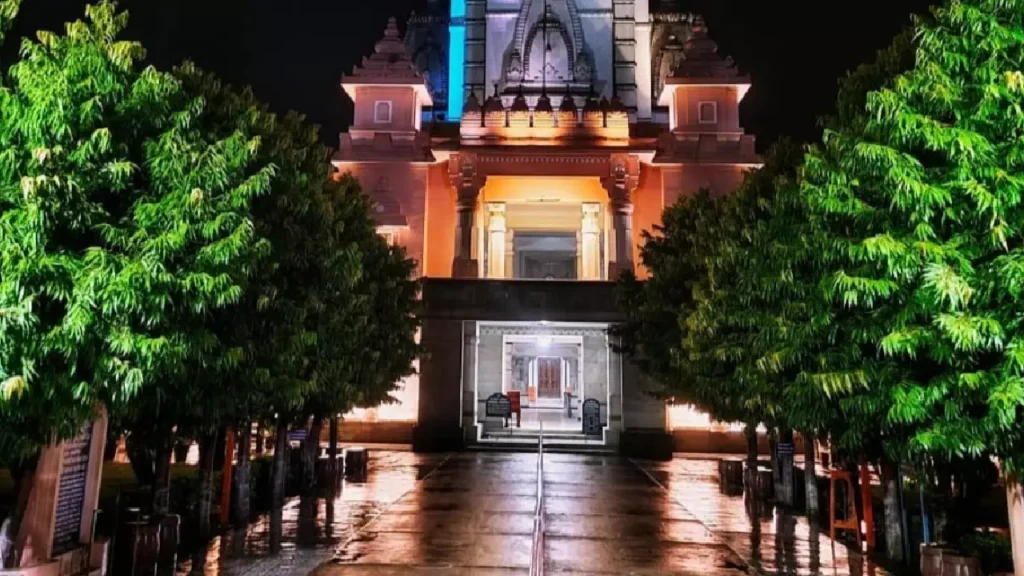
The Vishwanath Temple on the campus of Banaras Hindu University (BHU) is one of the finest examples of temple architecture in modern India — a soaring white marble structure that rises 77 metres above the BHU campus and is visible from much of southern Varanasi. While the original Kashi Vishwanath Temple in the old city is the most sacred Jyotirlinga shrine dedicated to Lord Shiva, the BHU Vishwanath Temple — often called the New Vishwanath Temple — was built to embody the same spiritual significance in a form that is more architecturally grand, more accessible, and more deeply rooted in the cultural vision of modern India’s Hindu renaissance.
The temple was conceived and initiated by Pandit Madan Mohan Malaviya, the visionary scholar-statesman who founded Banaras Hindu University in 1916. Malaviya envisioned BHU not merely as an academic institution but as a centre for the revival of Hindu civilisational values. The Vishwanath Temple was to stand at the spiritual heart of this vision — a temple that was open to all Hindus, regardless of caste or background, and that would demonstrate through its very beauty the glory of India’s living tradition.
Construction and Architecture
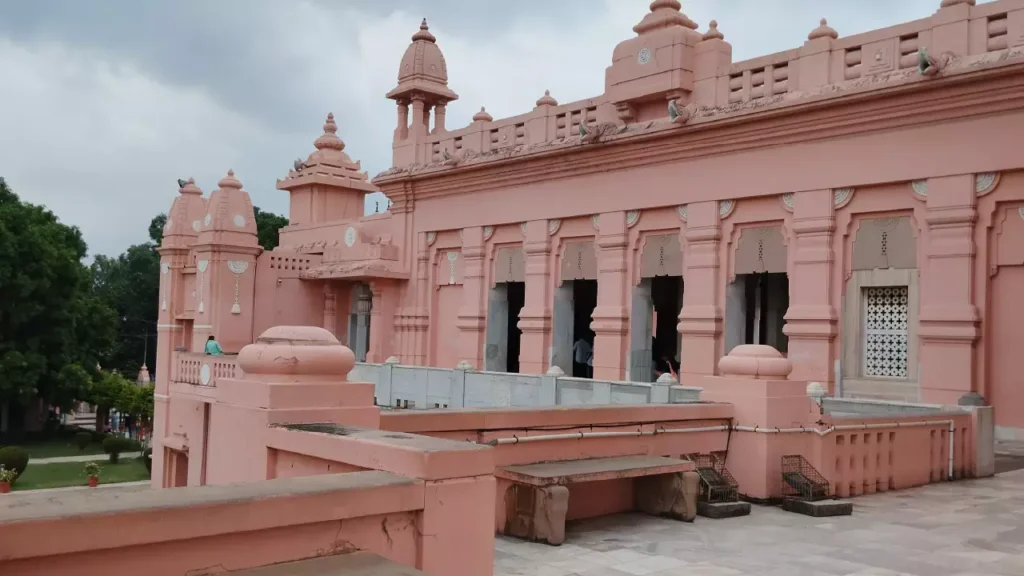
The temple was funded largely through the munificence of Raja Baldev Das Birla and was completed in 1966. Its design reflects a masterful synthesis of two great North Indian temple traditions: the Nagara style of the Orissan and Chandela schools (visible in the soaring curvilinear shikhara) and the influence of the Maratha architectural tradition (visible in the intricately carved mandapa, or assembly hall). The entire structure is built in pure white Rajasthani marble, giving it a luminous quality that changes with the angle of light throughout the day.
The main spire rises to 77 metres — making it one of the tallest temples in India. Surrounding the central Vishwanath shrine are five subsidiary temples dedicated to Goddess Lakshmi Narayan, Goddess Durga, Lord Ganesha, Lord Surya (the Sun God), and Goddess Saraswati, making the complex a mini-pilgrimage circuit in itself. Each subsidiary shrine is built to the same high standard of craftsmanship as the main temple, with detailed stone carvings depicting scenes from the Puranas and the epics.
The carvings on the outer walls are particularly noteworthy. Panels depict the Dashavatar (ten avatars of Vishnu), scenes from the Mahabharata and Ramayana, and the celestial battles described in the Puranas. The attention to iconographic detail is remarkable — these are not decorative motifs but carefully planned theological statements in stone. Scholars of Hindu iconography have cited the BHU Vishwanath Temple as one of the most iconographically complete temples built in the 20th century.
The Shivlinga and Inner Sanctum
The main sanctum sanctorum houses a Shivlinga (the abstract, aniconic form of Shiva) — the symbolic representation of Shiva’s infinite and formless nature. In keeping with Varanasi’s identity as the city of Shiva, the linga here is worshipped with the same rituals as the Kashi Vishwanath Jyotirlinga: daily abhishek with milk, honey, ghee, and Ganga water; offering of bel patra (bilva leaves); and formal aarti at prescribed times of the day. The atmosphere inside the sanctum, despite the temple’s modern origins, has the concentrated devotional intensity of a very old sacred space.
Darshan Timings and Accessibility
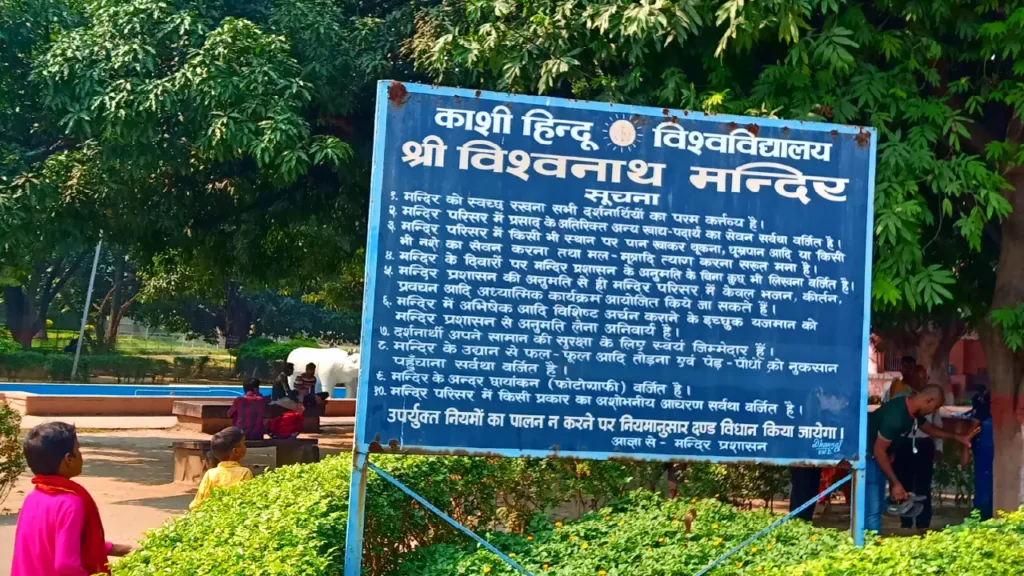
The temple is open from 5:00 AM to 12:00 PM and from 4:00 PM to 9:00 PM. Darshan is free for all visitors. Unlike the Kashi Vishwanath Temple in the old city, where entry is restricted to Hindus and the complex can feel overwhelming during peak hours, BHU Vishwanath Temple is more spacious, orderly, and accessible. This makes it particularly suitable for families with children, elderly pilgrims who find the narrow lanes of the old city difficult to navigate, and first-time visitors to Varanasi who wish to experience temple worship in a calm, beautiful environment.
The BHU campus itself is a destination worth exploring — a 1,300-acre green campus with gardens, the Bharat Kala Bhavan museum (housing an outstanding collection of miniature paintings, sculptures, and textiles), and the BHU Botanical Garden. Many visitors combine a morning visit to the temple with an afternoon at the museum.
Major Festivals
Mahashivratri is the temple’s biggest festival, with all-night vigil, massive queues for darshan, and special abhishek ceremonies throughout the night. Shravan month (July-August) is also particularly auspicious, with Kanwariyas (Shiva devotees who carry Ganga water on foot) arriving to offer water to the Shivlinga. Ram Navami, Hanuman Jayanti, and Navratri are observed with special programmes that reflect the temple’s pan-denominational character — it welcomes all traditions within the Hindu fold.
Malaviya’s Vision
To understand the BHU Vishwanath Temple fully, one must understand Malaviya’s vision for Hindu University. He believed that the revival of India depended on reconnecting Indians with their philosophical and spiritual heritage — not as museum pieces but as living realities. The temple was not meant to be a tourist attraction but the spiritual anchor of a great university. Students at BHU begin and end their academic careers with this temple as their constant presence. The rituals performed here connect ancient Vedic practice with modern educational life in a way that is unique in India.
Explore the spiritual and cultural heritage of Varanasi, including the BHU campus and the New Vishwanath Temple, through our Varanasi pilgrimage and travel guide. This temple is a key highlight of our Varanasi 2N/3D tour package.